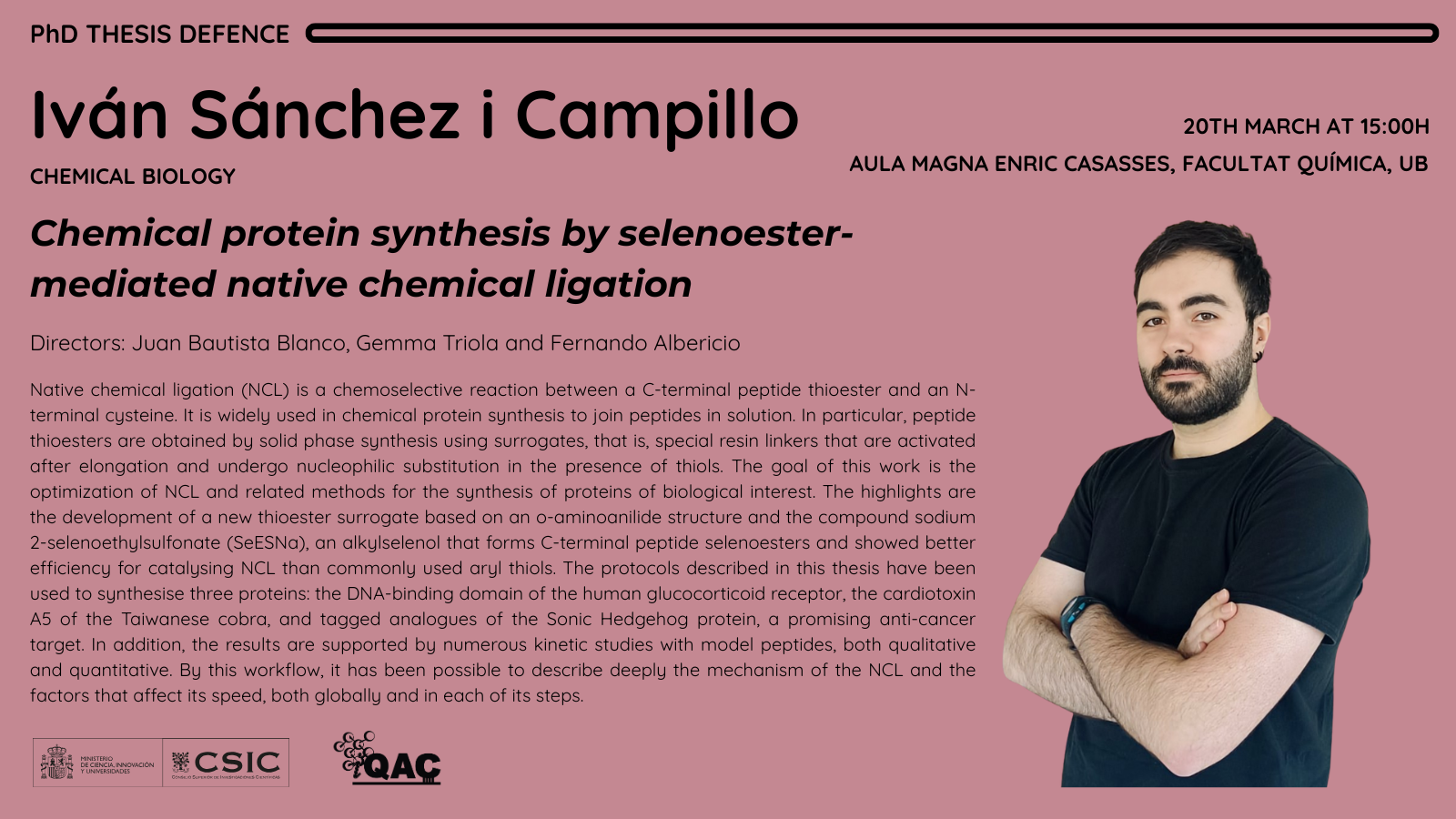
The predoctoral researcher Iván Sánchez i Campillo, from the Chemical Biology group, will defend his thesis on 20th March at 15:00h in Aula Enric Casassas (Faculty of Chemistry, University of Barcelona)
Title: Chemical protein synthesis by selenoester-mediated native chemical ligation
Directors: Juan Bautista Blanco, Gemma Triola and Fernando Albericio
Thesis committee: Alexander Shafir, Macarena Sánchez Navarro and Benjamí Oller Salvia
Abstract:
Native chemical ligation (NCL) is a chemoselective reaction between a C-terminal peptide thioester and an N-terminal cysteine. It is widely used in chemical protein synthesis to join peptides in solution. In particular, peptide thioesters are obtained by solid phase synthesis using surrogates, that is, special resin linkers that are activated after elongation and undergo nucleophilic substitution in the presence of thiols. The goal of this work is the optimization of NCL and related methods for the synthesis of proteins of biological interest. The highlights are the development of a new thioester surrogate based on an o-aminoanilide structure and the compound sodium 2-selenoethylsulfonate (SeESNa), an alkylselenol that forms C-terminal peptide selenoesters and showed better efficiency for catalysing NCL than commonly used aryl thiols. The protocols described in this thesis have been used to synthesise three proteins: the DNA-binding domain of the human glucocorticoid receptor, the cardiotoxin A5 of the Taiwanese cobra, and tagged analogues of the Sonic Hedgehog protein, a promising anti-cancer target. In addition, the results are supported by numerous kinetic studies with model peptides, both qualitative and quantitative. By this workflow, it has been possible to describe deeply the mechanism of the NCL and the factors that affect its speed, both globally and in each of its steps.