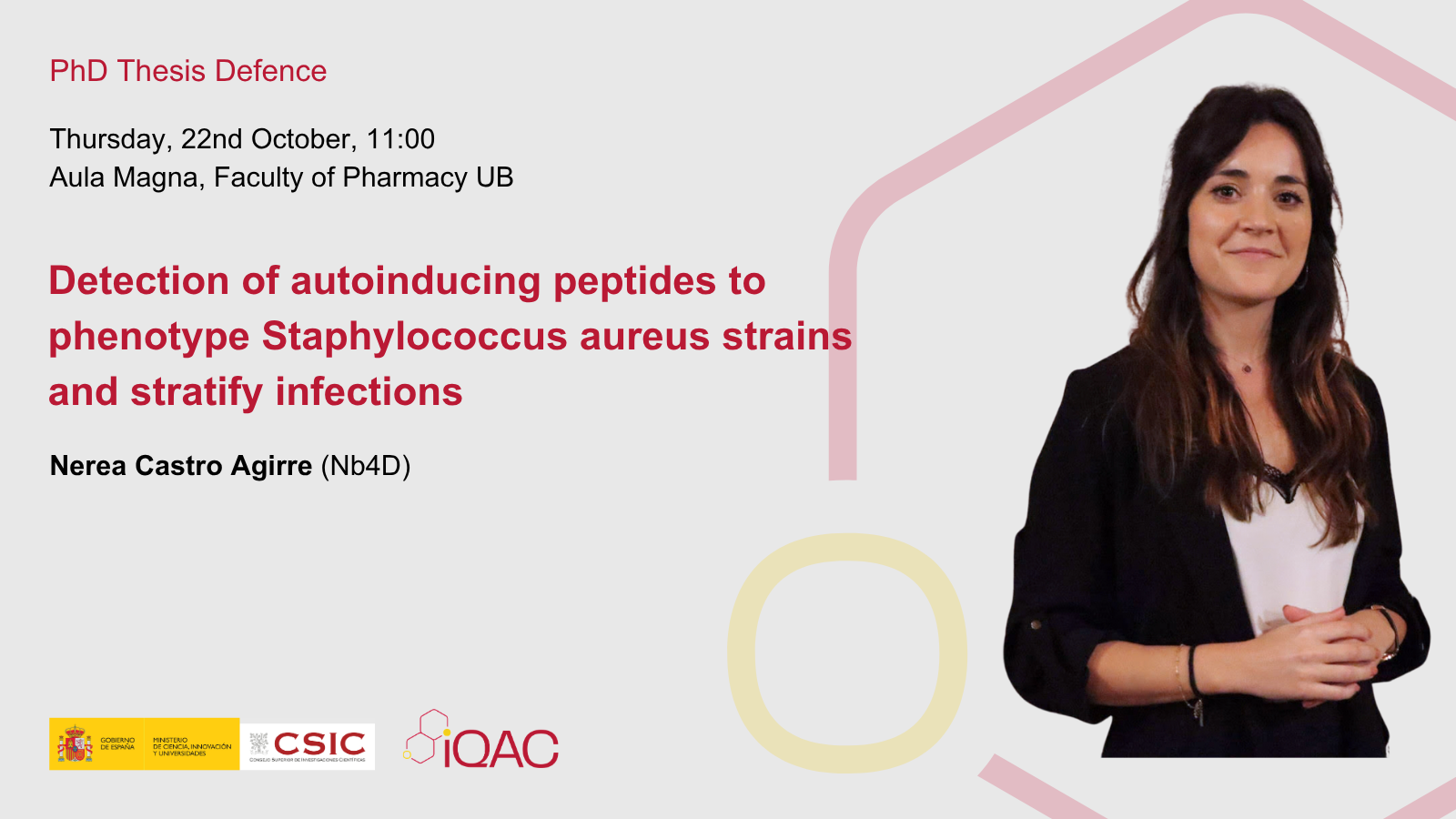
La investigadora predoctoral Nerea Castro Agirre (Nb4D) defensarà la seva tesi el 22 d’octubre a les 11:00h en l’Aula Magna de la Facultat de Farmàcia (Universitat de Barcelona)
Títol: Detection of autoinducing peptides to phenotype Staphylococcus aureus strains and stratify infections
Directors: J.-Pablo Salvador y Pilar Marco
Tribunal: Susana Campuzano, Karen Moreau y María Ángeles Domínguez
Abstract:
Staphylococcus aureus is a Gram-positive responsible for a wide spectrum of infections worldwide, ranging from superficial skin and soft tissue infections to severe, life-threatening conditions such as pneumonia and bloodstream infections. Its remarkable adaptive capacity, together with the production of a wide array of virulence factors, has contributed to its persistence and clinical relevance. In addition, the increasing prevalence of multidrug-resistant strains, such as methicillin-resistant S. aureus (MRSA), poses a major and growing threat to public global health.
This thesis focuses on developing immunochemical diagnostic tools for the rapid detection of S. aureus infections. The work targets the main quorum sensing (QS) system of this pathogen, known as the accessory gene regulator (agr) system, which controls the transition from a commensal state to an invasive phenotype in a population density-dependent manner. This regulation is mediated by the production and sensing of four signalling molecules known as autoinducing peptides (AIPs 1-4), which activate the agr system upon reaching threshold concentrations. In this context, AIPs are proposed as diagnostic biomarkers for S. aureus, enabling strain-level phenotyping according to agr type and supporting the development of targeted diagnostic and therapeutic strategies.
The preceding results in the group led to the identification of a previously undescribed molecular form of the AIPs consisting of a linear structure (open thiolactone) of the peptide, termed here AIPo. In this work, a novel conjugation strategy was developed to couple AIPo haptens to carrier proteins via amino-amino linkage immunogen preparation. Polyclonal antibodies against AIPo 1-4 were generated and applied in enzyme-linked immunosorbent assays (ELISAs), which were characterized in terms of detectability, specificity, accuracy, reproducibility, precision and robustness. The optimized ELISAs exhibited outstanding sensitivity, with low IC50 values (25.70 nM for AIP1o; 46.37 nM for AIP2o; and 2.19 nM for AIP3), surpassing conventional analytical techniques such as mass spectrometry.
The assays were adapted for AIP detection in bacterial culture medium (TSB), enabling the study of AIP release kinetics as well as strain stratification analyses. Kinetics studies demonstrated that the simultaneous detection of both closed and open forms of AIPs is essential for accurate and complete quantification of total AIP levels, as neglecting the open form leads to a significant loss of relevant information that may be critical for diagnostic interpretation. The analysis of bacterial isolates obtained from of clinical respiratory samples revealed differences between colonization- and infection-associated S. aureus strains. Furthermore, an additional study was performed including blind samples of S. aureus isolated from skin wounds, in which the specificity and sensitivity were evaluated for the phenotyping discrimination of each agr type.
Overall, this thesis highlights the potential of AIPs as biomarkers for rapid diagnosis of S. aureus infections, enabling discrimination between infection stages, phenotyping of strains (agr I-IV), and disease monitoring. In this way, the presented work represents a significant advance in the field of S. aureus diagnostics, providing rapid, sensitive, and clinically applicable tools. Although further studies are required to validate these approaches and expand their implementation across different platforms, their application in biological samples could substantially improve disease management and treatment, while contributing to reduce the burden of antimicrobial resistance.