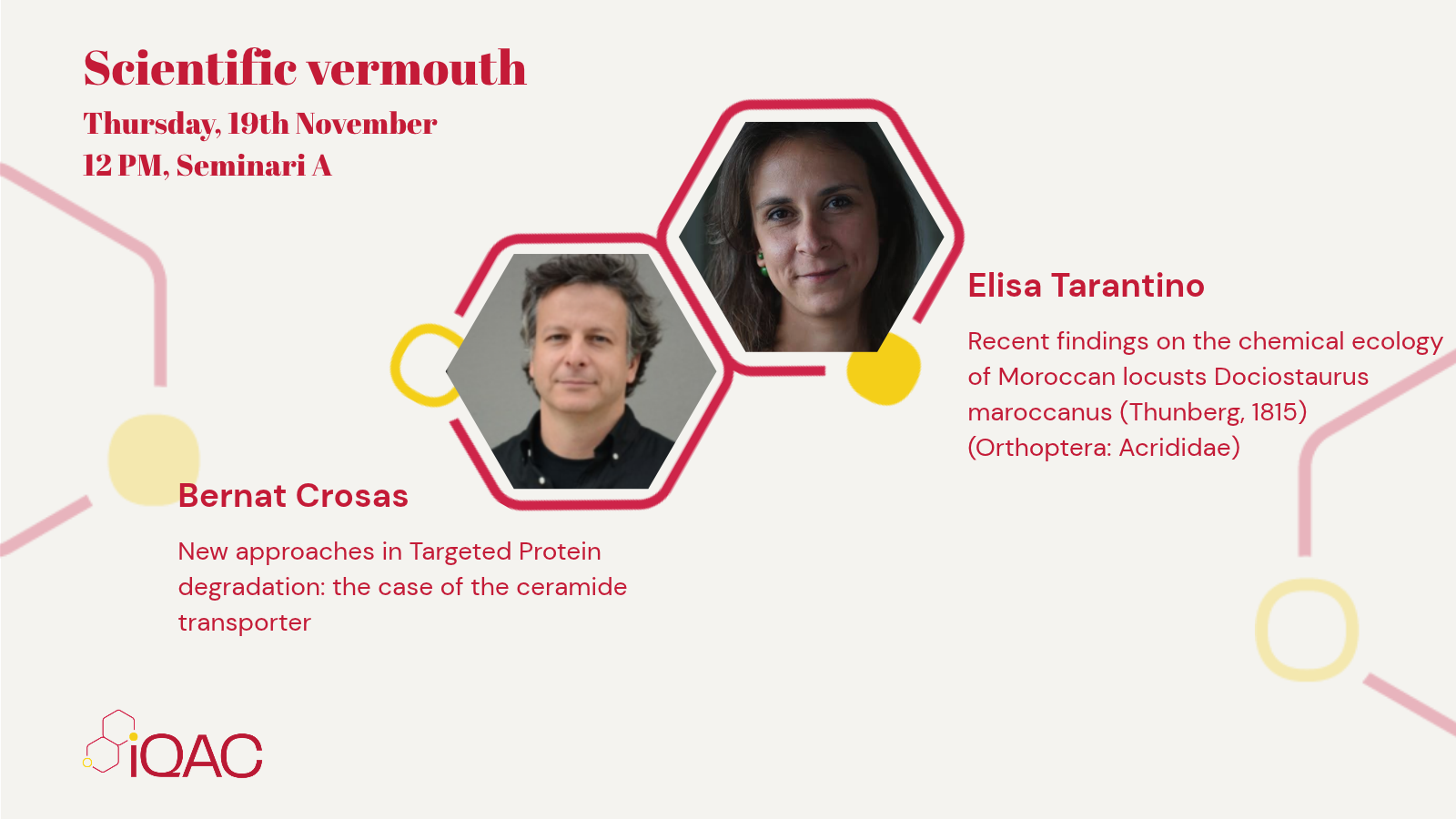
Els investigadors Bernat Crosas (ponent convidat de l’IBMB-CSIC) i Elisa Tarantino (Química ecològica d’insectes plaga) participaran en aquest Scientific Vermouth, el 19 de novembre a les 12:00 h, amb les següents ponències:
- Bernat Crosas – New approaches in Targeted Protein degradation: the case of the ceramide transporter
Proximity-inducing pharmacology, and in particular proteolysis-targeting chimeras (PROTACs), has become one of the most dynamic areas of drug discovery. A PROTAC is a chimera that couples a ligand for a protein of interest (POI) to a ligand for an E3 ubiquitin-ligase; the induced ternary complex ubiquitinates the POI and marks it for 26S-proteasomal degradation. Despite dozens of clinical programs, the field rests on a strikingly narrow base: essentially all advanced degraders recruit just two E3s: CRBN or, secondarily, VHL. This bottleneck imposes real limits — restricted tissue/compartment expression of the ligase, dependence on accessible surface lysines, and, for CRBN, obligatory co-degradation of molecular glue-induced neosubstrates (thalidomide mediates the depletion of IKZF1/IKZF3, SALL4 by CRBN).We have explored and validated a fundamentally different modality: small-molecule chimeras -not peptidic macrocycles- that recruit the 26S-proteasome deubiquitinase USP14 to deliver targets for degradation in a E3- and ubiquitin-independently manner. Proof of concept comes from a key cellular factor, the ceramide transporter CERT1, where induced degradation has uncovered subtleties in the control of this central lipid regulator and a profound effect on cell homeostasis with antineoplastic potential. In this seminar the novel chimera approach will be introduced and sphingolipid-dependent vulnerabilities in cancer cells, induced by CERT1 loss, will be discussed.
- Elisa Tarantino – Recent findings on the chemical ecology of Moroccan locusts Dociostaurus maroccanus (Thunberg, 1815) (Orthoptera: Acrididae)
The Moroccan locust Dociostaurus maroccanus (Thunberg, 1815) (Orthoptera: Acrididae) is a pest of many crops that has traditionally been managed with pesticides. However, the arising awareness for pesticides adverse effects on environment and human health led to the development of pest control strategies more respectful of the environment. In this context, the identification of chemical signals capable of manipulating insect behavior (semiochemicals) emerges as a promising strategy for insect pests. In a recent study we focus on two male-specific aldehydes previously identified, namely tetradecanal and hexadecanal, and we also identify for the first time the pentadecanal. These aldehydes are male-specific compounds and their release follow an age-dependent pattern, being completely absent in the volatile profile of the immature stages. The olfactory perception these aldehydes have been assessed and females of both mating status (virgin and mated) can perceive these compounds, although differences in the perception depending on the mating status have emerged.Also, differences in the behavioral response depending on the mating status are observed in double-choice olfactometric assays: virgin females only show a preference for hexadecanal, mated individuals are significantly attracted to tetradecanal and pentadecanal.
Overall, our findings provide a preliminary basis for identifying putative pheromones in the Moroccan locust, although comprehensive research is still needed to determine the role of these aldehydes in the species’ chemical communication.