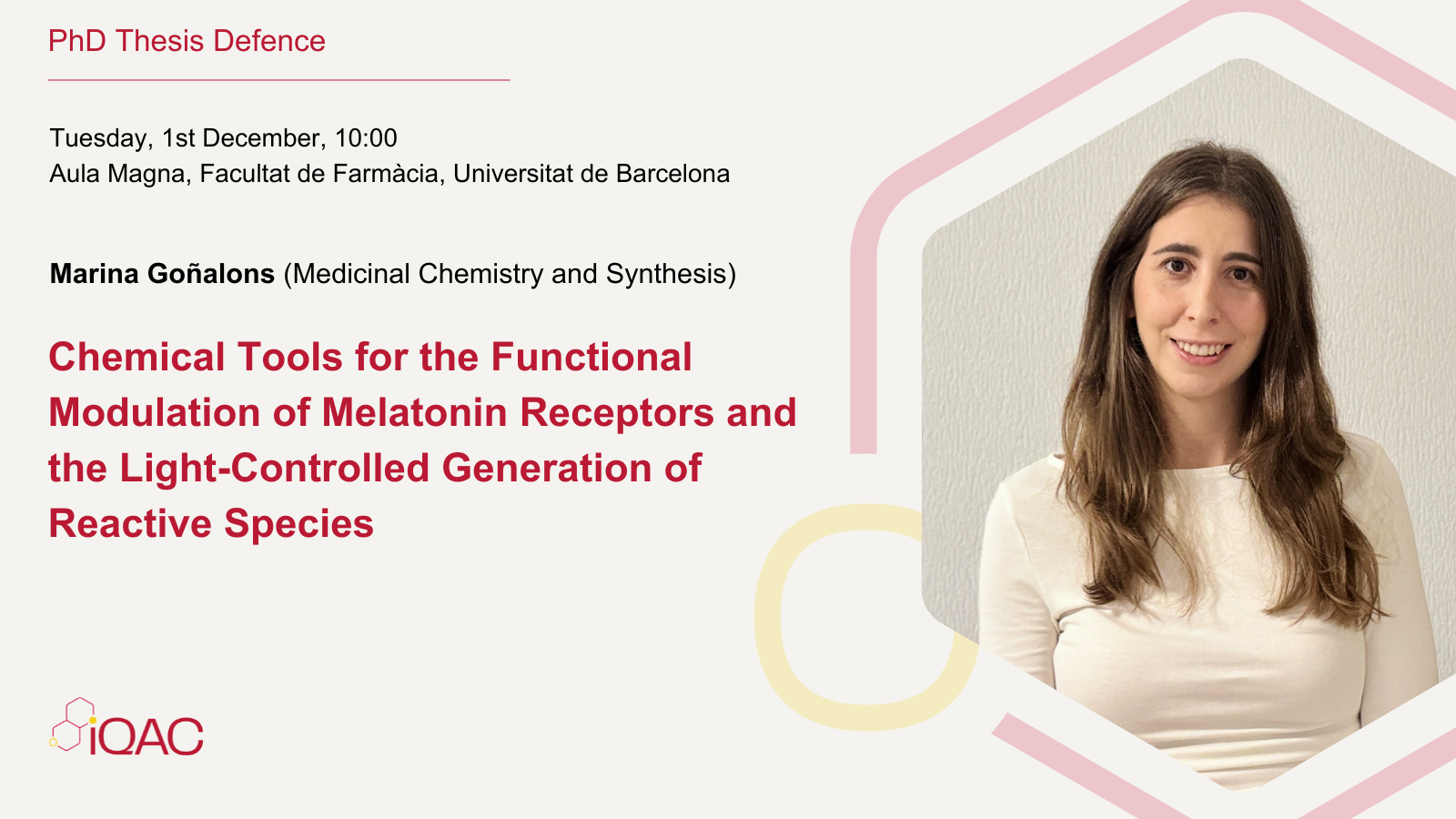
The predoctoral researcher Marina Goñalons will defend her thesis on 1st December at 10:00h in Aula Magna (Faculutat de Farmàcia, Universitat de Barcelona)
Title: Chemical Tools for the Functional Modulation of Melatonin Receptors and the Light-Controlled Generation of Reactive Species
Directors: Lourdes Muñoz and Xavier Rovira
Thesis Committee: Rodolfo Lavilla, Laia Josa-Culleré and Albert Antolín
Abstract:
The development of novel tools provides a powerful approach to probe and modulate specific mechanisms in complex systems. In this context, this thesis describes the design, synthesis, and evaluation of novel chemical tools developed along two main research lines: the investigation of melatonin receptor signaling using selective ligands and photopharmacological approaches, and the development of photosensitive nitroaromatic systems for the controlled generation of reactive species.
Melatonin receptors, MT1 and MT2, are class A G protein-coupled receptors that regulate circadian rhythms and the sleep-wake cycle and have also been implicated in metabolic and neurodegenerative disorders, as well as oncological, inflammatory, and cardiovascular conditions. These diverse biological roles make them attractive
therapeutic targets. However, the precise contribution of each receptor subtype, signaling pathway, and receptor population remains poorly understood due to the scarcity of chemical tools able to modulate signaling with refined spatiotemporal and functional resolution.
The first research line addressed MT1 receptor pharmacology at multiple levels, including subtype selectivity, functional response, and subcellular localization. To explore the molecular basis of MT1-selective recognition and activation, structurally diverse melatonergic ligands were developed, pharmacologically evaluated, and analyzed using molecular docking. These studies identified structural features associated with MT1 preference and revealed distinct relationships between selectivity and functional response. This work was further extended to the subcellular level through the development of caged melatonergic ligands as photopharmacological tools to study mitochondrial MT1 signaling, providing a strategy to distinguish mitochondrial responses from plasma membrane signaling.
The second research line focused on photoactivatable systems capable of generating reactive species upon irradiation. While nitroaromatic photocages are widely employed for cargo release, less attention has been devoted to the utility of photoproducts generated during photocleavage. In particular, nitroso-containing species are typically regarded as byproducts despite their chemical reactivity and potential synthetic and biological relevance.
This thesis introduces a new family of N1-substituted 7-nitroheterocycles designed for the controlled generation of reactive photoproducts. This system enables the concurrent release of carbonyl and nitroso species from a single precursor, providing a strategy to harness two complementary reactive compounds with broad potential across chemical synthesis and light-dependent biological applications.