


The Institute for Advanced Chemistry of Catalonia (IQAC) and the Institut de Recerca Sant Joan de Déu are joining forces for the conference ‘From the laboratory to the hospital: advanced chemistry and paediatric research’ to bring their research teams together, share knowledge and promote new joint projects.
On 26 November, researchers from the Institute for Advanced Chemistry of Catalonia (IQAC-CSIC) and the Institut de Recerca Sant Joan de Déu (IRSJD) gathered at the IRSJD’s training centre to take part in event ‘From the laboratory to the hospital: advanced chemistry and paediatric research’. The meeting had a clear objective: to align research in advanced chemistry with the needs of paediatric research, fostering new collaborations between the two centres, identifying opportunities to develop biomedical projects, and sharing knowledge and resources.
As a result of this initiative, any joint projects arising from the workshop will be eligible to apply for the first round of IRSJD-IQAC Seed grants, which will allocate 10,000 euros to fund two research projects in chemistry applied to therapies for childhood diseases. The initiative aims to foster these collaborations and enable them to apply for competitive funding schemes in the future.
Two centres, a shared commitment: linking research to clinical needs
The event began with an official welcome and a presentation of both centres and their respective technological platforms.
Olga López, director of IQAC-CSIC, emphasised that, although the two institutes already collaborate, this was the first time an event of this kind had been organised to strengthen relations between their research groups. She also stressed the importance of forging links with the IRSJD to advance the commitment to translating chemical knowledge beyond the laboratory.
For his part, Joan Comella, director of the IRSJD, highlighted that finding solutions to unmet therapeutic needs requires incorporating diverse perspectives and knowledge. He also pointed out that collaborations do not begin when funding is sought or a project is submitted to a call for proposals, but much earlier: through conversations and exchanges between researchers. In this regard, he highlighted the value of initiatives such as this one in creating spaces for dialogue and new opportunities for collaboration.
Speed dating to find new opportunities for collaboration
To encourage the exchange of ideas, the event was organised around brief meetings between researchers from both centres, grouped by research area. This format, known as ‘scientific speed dating’, allows participants to hold multiple conversations in a short space of time and to identify common interests and potential avenues for joint research.
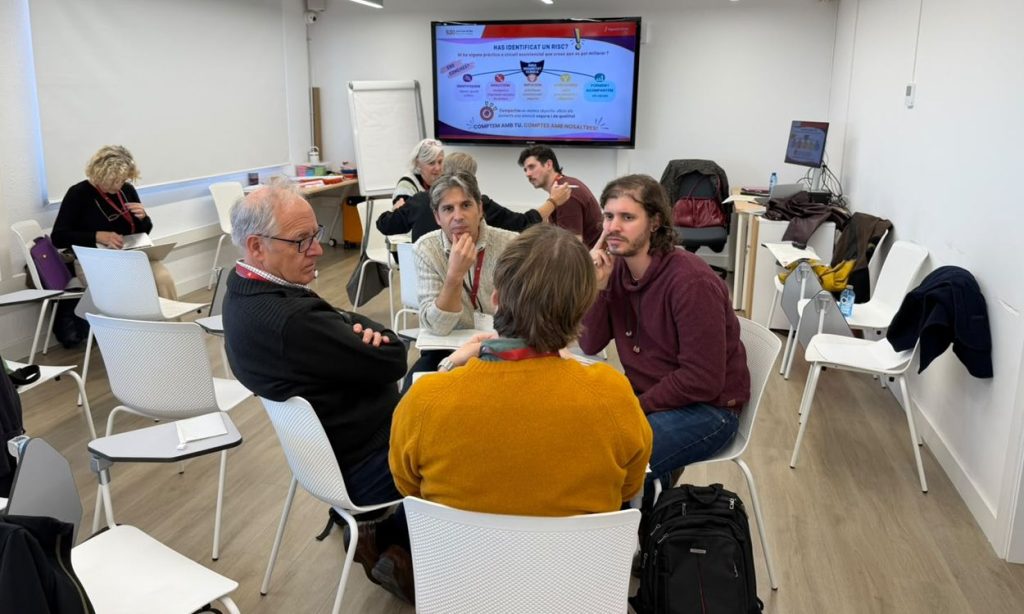
In total, each participant took part in six twenty-minute meetings, resulting in more than forty meetings taking place amongst those present. The discussions focused on areas such as childhood cancer, neuroscience and infectious diseases.
The aim is for these initial connections to lead to new research projects and future applications to the IRSJD-IQAC Seed grant scheme. The event concluded with a working lunch, which provided an opportunity to continue sharing ideas and strengthen the relationships forged during the meetings.
IRSJD-IQAC Seed Grants: an opportunity to promote joint projects
The first call for applications for the IRSJD-IQAC Seed Grants aims to foster collaboration between research teams at both centres and to promote projects in chemistry applied to the development of therapies for childhood diseases. Proposals must be submitted jointly by principal investigators from the Institute for Advanced Chemistry of Catalonia (IQAC-CSIC) and the Institut de Recerca Sant Joan de Déu (IRSJD).
The call has a total budget of 10,000 euros, which will fund two projects for one year, with a grant of 5,000 euros for each. The funding is intended to develop proof-of-concept studies that will advance the research and prepare it for submission to future competitive calls.
The deadline for submitting applications is 22 December 2026, and the results of the call are expected to be announced on 25 January 2027.