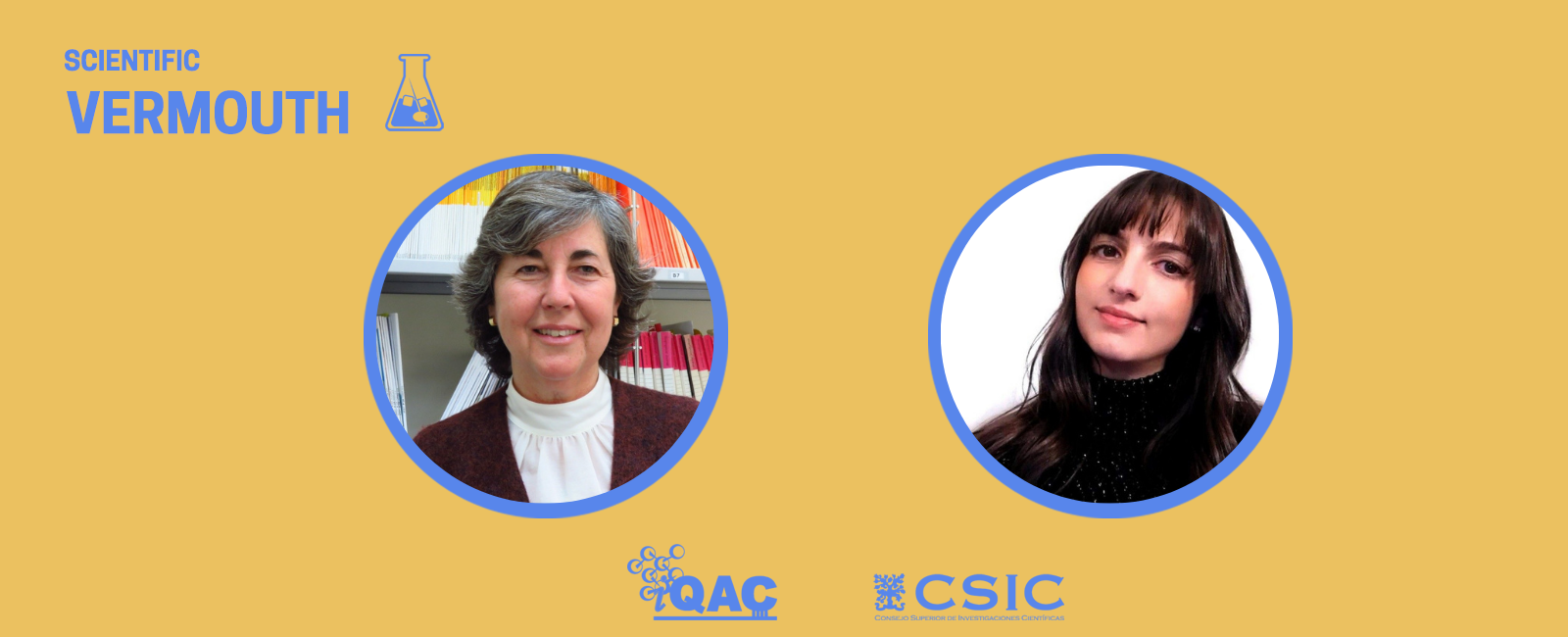
The researchers Luisa Coderch (Biocompatible Surfactants and Ionic Liquids) and Diletta Arceri (Biotransformation and Bioactive Molecules) will participate in this seminar session of Scientific Vermouth, on 22nd January at 12:00h, with the following talks:
- Luisa Coderch – Raw Wool as Infill for Artificial Turf
Raw wool, a natural fibre, is presented as a new natural biodegradable alternative infill for artificial turf fields. In the sports fields area, there have been concerns about toxic chemicals found in tyre particles used as infill in artificial grass and other playsurfaces. These considerations have driven a rising market for alternative infills. The search for more sustainable alternatives led to raw wool waste being evaluated as a renewable, biodegradable resource. Attention was therefore focused on viable ways of turning a troublesome waste product into a material with added value.
This work, presents the raw wool as a new natural alternative infill for artificial turf fields. Pellet-suitability of different types of wool, water inclusion and/or density-increasing additives were studied to optimize pellet production for artificial grass surfaces. The “Advanced Artificial Athlete” (AAA) were evaluated to mimic the heel strike of an athlete on the surface when running, important for sport performance and for the safety of players. Due to wool’s water absorption capacity, static electricity is also expected to be significantly reduced compared to SBR infill, which will improve player comfort. Their feasible application as grass infill was proved. At the moment, wool pellets have been produced on a small scale, but it is expected that they will be scaled up appropriately for possible market needs. - Diletta Arceri – Cupin-type dimethylsulfoniopropionate lyase from Pelagibacter Ubique (DddKPu) catalyzes aza-Michael addition of primary and secondary amines to acrylic acid
The formation of carbon-nitrogen (C–N) bonds is a cornerstone of organic synthesis, enabling access to amines and nitrogen-containing scaffolds central to many bioactive molecules. Among the established methods for C–N bond formation, the aza-Michael addition stands out as a powerful route to β-amino acids and related derivatives. However, biocatalytic approaches have so far required activated acrylate derivatives, since the direct use of acrylic acid as a Michael acceptor has remained unprecedented in enzymatic catalysis.
I will introduce a biocatalytic approach that overcomes this limitation by exploiting an unprecedented form of catalytic promiscuity in the cupin-type DMSP lyase from Pelagibacter ubique HTCC1062 (DddKPu). Although this enzyme naturally catalyzes a β-elimination (a retro–sulfa-Michael reaction), we show that it can also activate acrylate through metal coordination and promote its forward aza-Michael addition with primary and secondary amines, a reactivity not previously documented for this enzyme class within biocatalysis. I will discuss how the wild-type enzyme supports a broad range of secondary amines, and how a structure-guided mutation (W26G) enhances its performance with less nucleophilic primary amines, while preserving remarkable chemoselectivity.
These findings reveal DddKPu as a versatile biocatalyst capable of furnishing N,N-disubstituted and N-substituted β-amino acids with high selectivity, expanding the biocatalytic toolbox for C–N bond formation and enabling streamlined access to pharmaceutically relevant scaffolds.