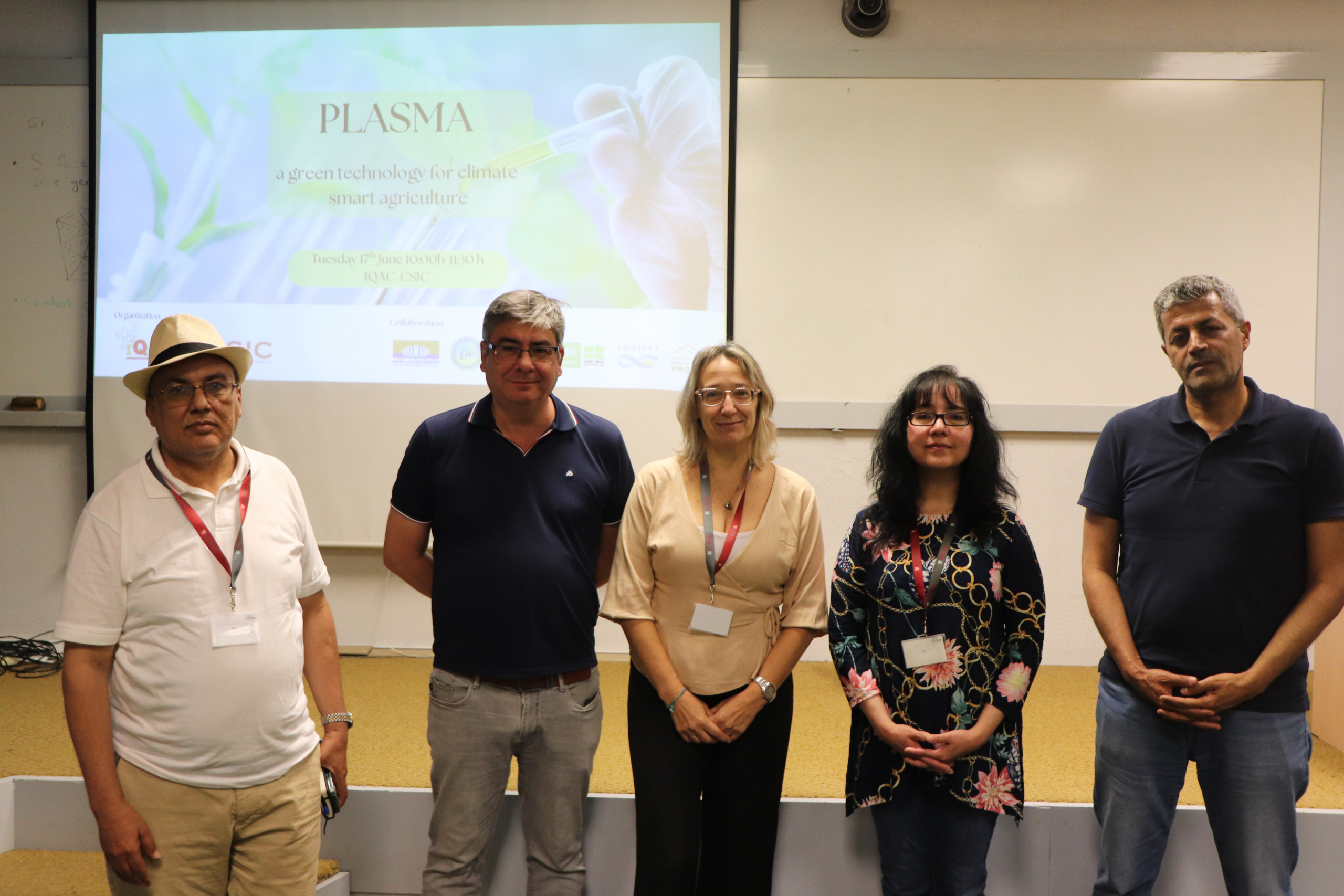
On 17th June, IQAC researcher Ricardo Molina organised the conference “Plasma: a green technology for climate-change agriculture”, where the fundamental principles of plasma were presented as an innovative and environmentally friendly tool for agricultural applications.
Through different talks and guest speakers such as Dr Mohamed Ali Benabderrahim (Institut des Régions Arides, Tunisia), Dr Karina Balestrasse (CONICET, Argentina), and Dr Carla Quiroga (Fundación PROINPA, Bolivia), it became clear how plasma can help address current agricultural problems by being applied in the treatment of seeds, flours, and starches, as well as its implementation in crops.
Currently, plasma is used for the removal of microcontaminants in water, with very positive laboratory results already observed. According to the researchers’ presentations, plasma application can increase water uptake by crops, reduce irrigation water consumption, and also act as an antibacterial and antifungal tool.
“We must take into account the various challenges we face in agriculture, beyond simply feeding over 8 billion people worldwide,” explains Ricardo Molina, researcher at IQAC-CSIC. “Prolonged droughts, rising temperatures, and antimicrobial resistance compel us to explore new alternatives, and plasma stands out as a highly promising option for this field.”
These talks were held within the framework of the LINCGLOBAL 2024 (Ref LINCG24012) and i-COOP 2024 (Ref COOPB2428) projects.